

I was already excited about hyper-soft: double-down before knowing much about it. With a line-up of talented friends and young artists who were already on my radar, I was miffed to miss the opening (which I heard was a riot), even if I was in an unseasonably warm and sunny Copenhagen instead. A day into my return to Berlin, I head over to Klemm’s Downstairs, the younger sibling and project space of the eponymous gallery, where I am welcomed with fresh coffee and panettone – and who doesn’t love a little bit of special treatment, right? The project space, under the direction of Guilherme Vilhena Martins, has been showing consistently (and perhaps even increasingly) impressive exhibitions across various media, all with a focus on younger and emerging artists.
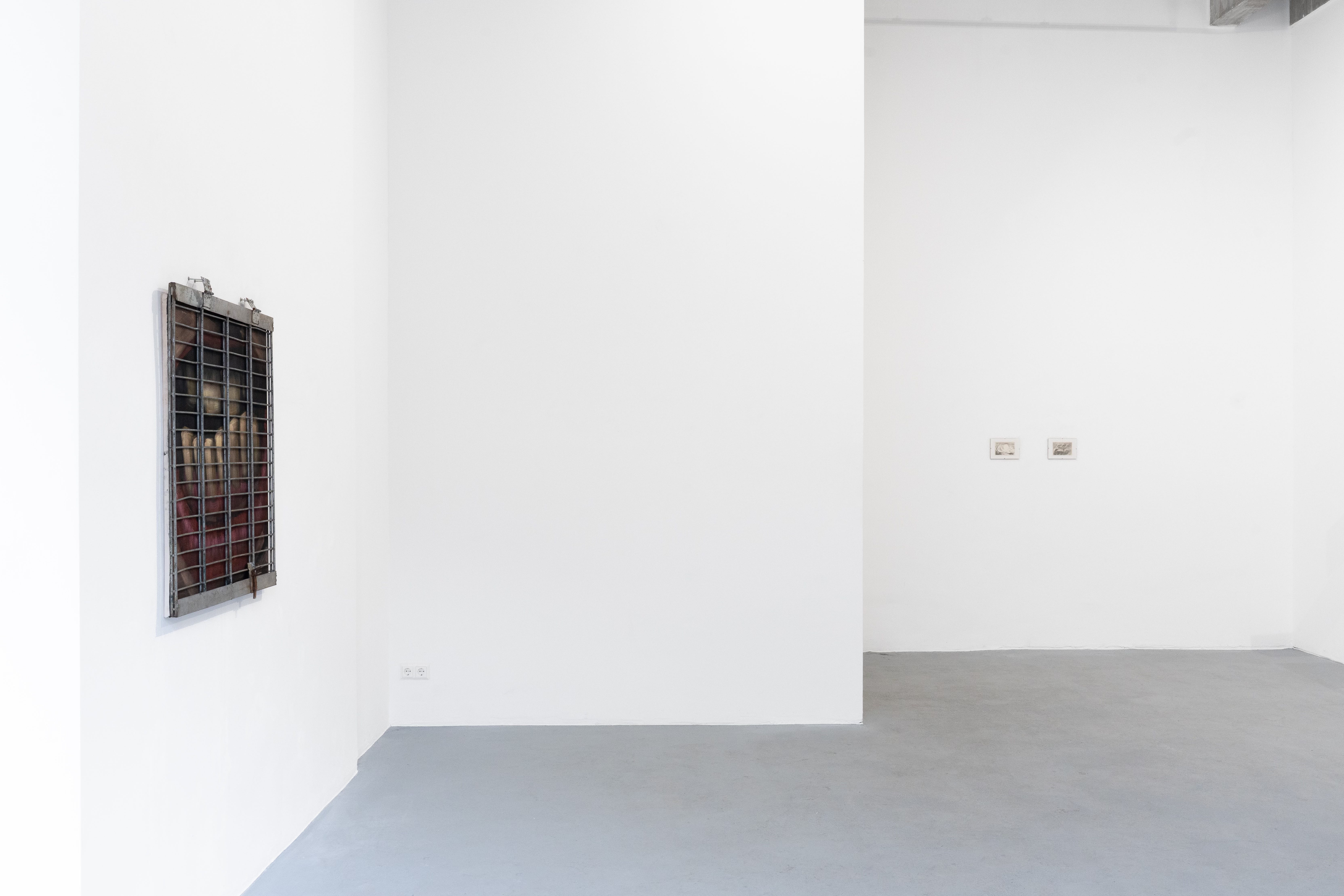
This time it’s a small group show with works by Maxime Chabal, Marcus Nelson and Sarah Neumann, curated by Guilherme himself. Spanning drawing, installation and painting, it essentially lingers ‘at the threshold between the bodily and the architectural.’ This abstract concept (which admittedly steered my thinking towards the ‘liminal space’) is turned into something solid through the physicality of the works and their curation: forms of shelter and containment, material transformation, the literal movement of bodies through the space.
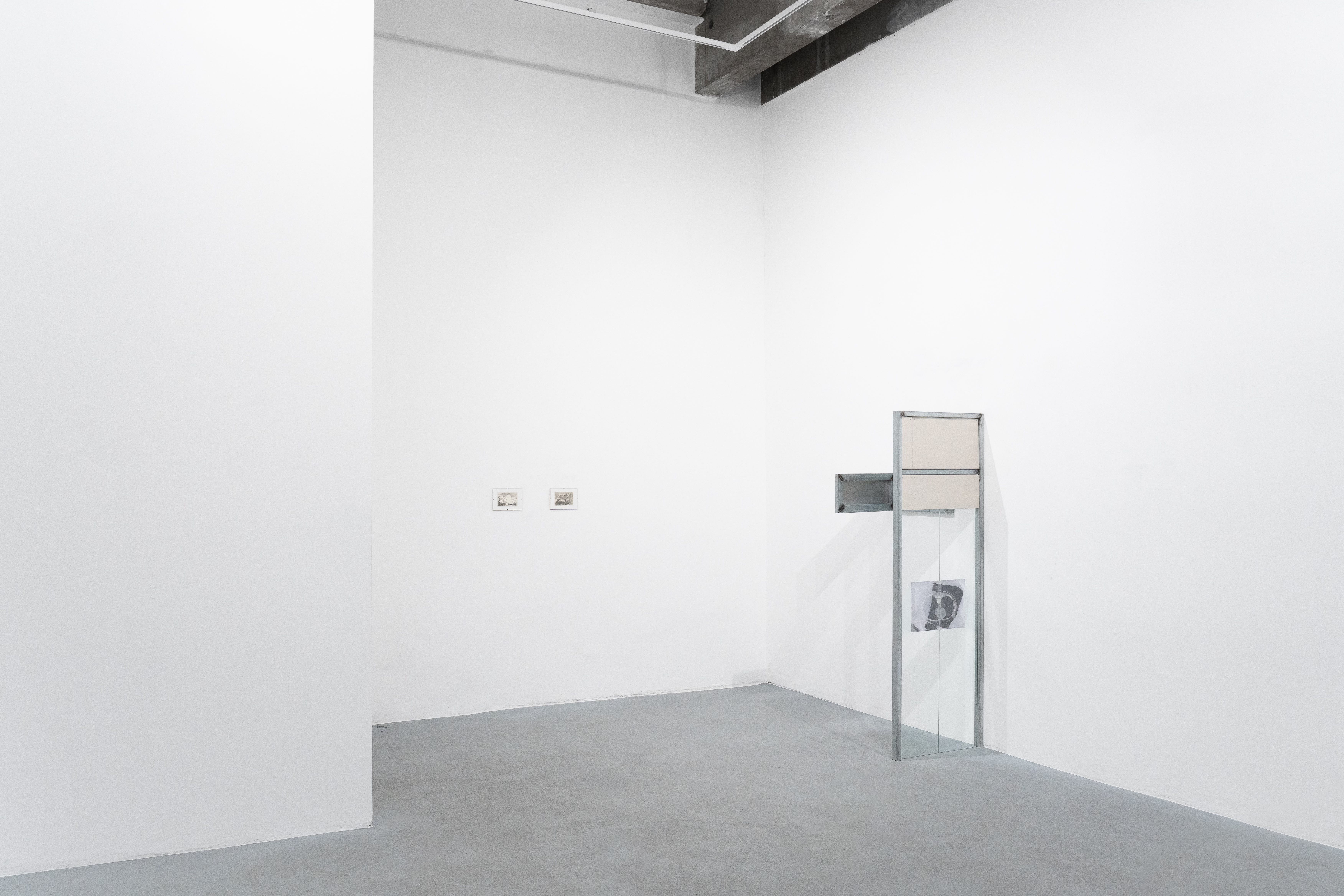
Guilherme Vilhena Martins: Yeah, so how did this whole thing start? I think I was still thinking in the broader framework in which Sarah was producing imagery: violence, anxiety, pressure, reacting to the outside world, mostly to space and the spaces we’re encapsulated in. We talked a lot about drawing and the basic gestures of drawing being above all as some form of shelter, you know, because it’s a reaction, but you’re coming up with something different. It’s a world-making strategy where you hide a bit, but also there’s a connection to the material source of drawing as a physical experience.
And that’s what brought me to these three positions. I was interested in this threshold between the bodily and the architectural, how the body moves through spaces, and how space is determined by the way you move. I was also interested in fiction or abstraction as a form of shelter.
And in Sarah’s practice that’s quite evident. The works clearly have traces of bodily elements: eyelashes, eyeballs, eyebrows. She uses drawing in a very peculiar way. It’s almost as though she’s painting, in that she erases a lot and draws over it again. It’s a very repetitive process, and obviously very focused on composition. But that also means that the initial figures change a lot, as you would normally see in a painting with layering. She erases, but keeps some traces. So you end up with this very abstract, but still slightly figurative composition.
Nadia Egan: It really feels like I’m reading a book, and this is what I’m seeing in my mind. You know, out on the grass, in a meadow or among the rushes.
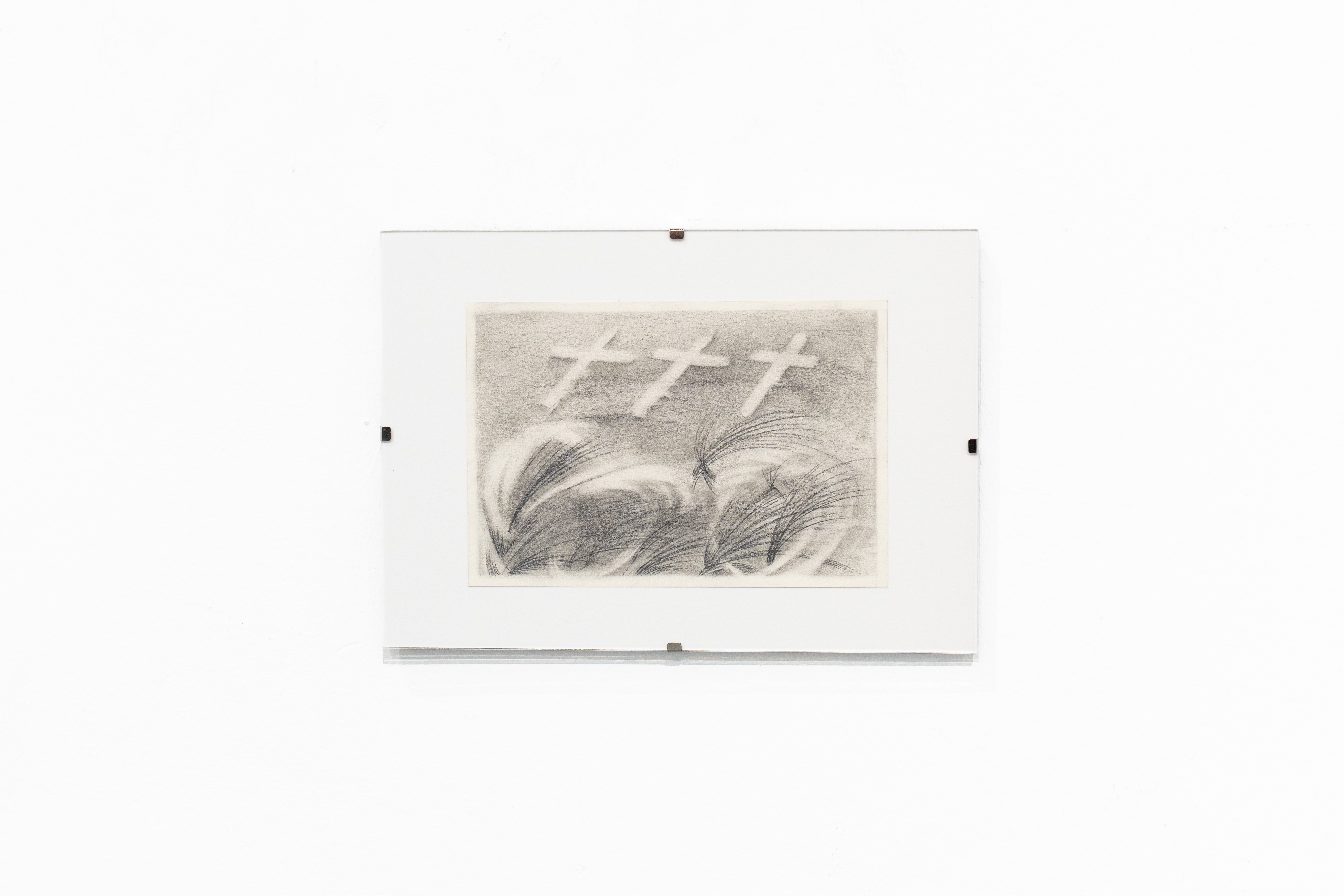
GVM: It’s pretty narrative, right? I think it’s a self-sufficient world, if you could call it that. It holds on its own, but it’s made of familiar elements. The crosses, for example, just get their meaning changed. This is also an interesting idea, this strategy of seizing violent structures and turning them into fictional elements where they play a different role in a somewhat still familiar landscape, but already abstracted. That’s kind of the sweet spot.
And this is similar to what Maxime is doing. Here it’s more evident on a material level, because he’s working with industrial materials like steel and aluminium – materials that would be used in cold infrastructures. And he’s literally designed this as a capsule. So it’s also about creating spaces to hide, as well as reappropriating this rather industrial land and infrastructures you move within.
And in a way, that’s also what Marcus is doing. Here the focus is really on the mouth – the whole thing works as a muzzle. There are some ideas of containment, but also it’s a very visceral, very violent expression. There’s also that ambiguity of the mouth as a portal – both super intimate and anonymous. It’s kind of like the concentrated version of a face, whereby you would recognise someone and it’s how they express themselves. But it’s also a door to something that you have completely no idea of. There’s an interiority that starts there, where the body could be imagined upside down.
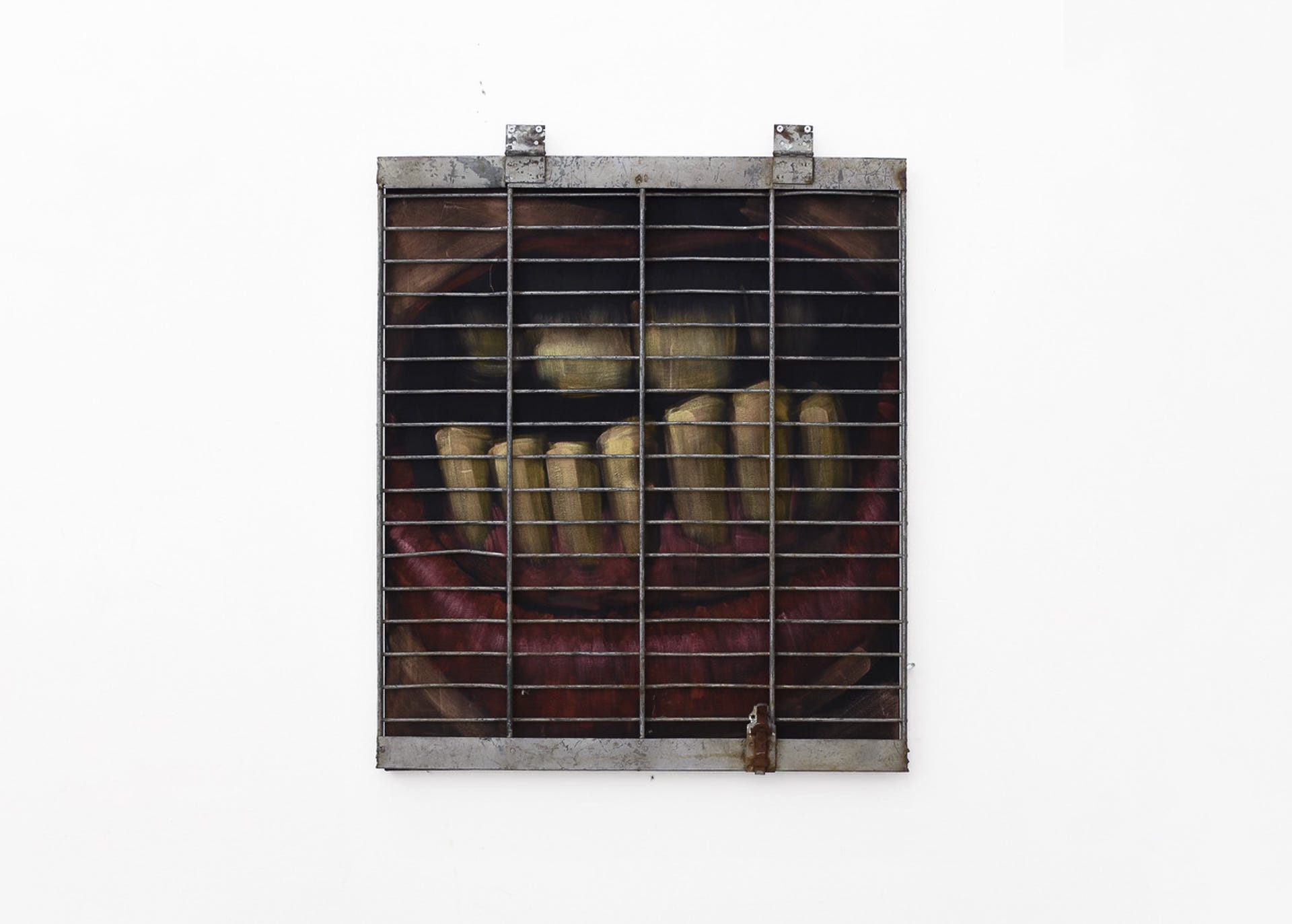
NE: I mean this in the best way I can – it’s hideous.
GVM: It’s hideous, yeah. 100% it’s hideous.
On a completely different level, it’s also connected to this idea of seizing structures, because the grate itself is an objet trouvé. This is something that Marcus has found in the street.
NE: He’s good at finding stuff. I’m always impressed when he says he finds all this ‘crap’ on the street, and then you see it in one of his pieces and it works perfectly.
GVM: He’s very good at finding stuff on the street. Which is also a pretty interesting flâneur-ist move, right? Moving through a place full of trash and disposed stuff that’s not functional anymore, and then you just reappropriate it as an element in an artistic composition. I think that’s kind of crazy.
There’s a theatre play by Samuel Beckett called Not I (1972), which is staged so that you have a huge curtain and the only thing you can see is a mouth that is sort of mumbling words. Marcus had developed a series of paintings around that, inspired by the theatre play and only seeing the mouth. As Marcus would put it, ‘the mouth is what you fuck with and where you get fucked through.’ It’s a very direct, omnipresent medium in a way. But it’s also the first hidden spot in your body. I don’t know if you have had that experience where you go to the dentist, and they’re like, ‘are you a smoker?’ And you’re like, ‘how the fuck do you know that?’ You think it’s all hidden. It’s the first place that this visceral dimension is brought to the surface. It’s always there, but you never notice it. It’s very discreet.
NE: For sure. How did you decide on bringing these artists together?
GVM: I already had the conceptual framework for the show. And in this particular case, I have a watch list. Then, depending on the conceptual framework, I pick the positions that make the most sense for us together. Considering the room, it’s nice to have some balance of different practices.
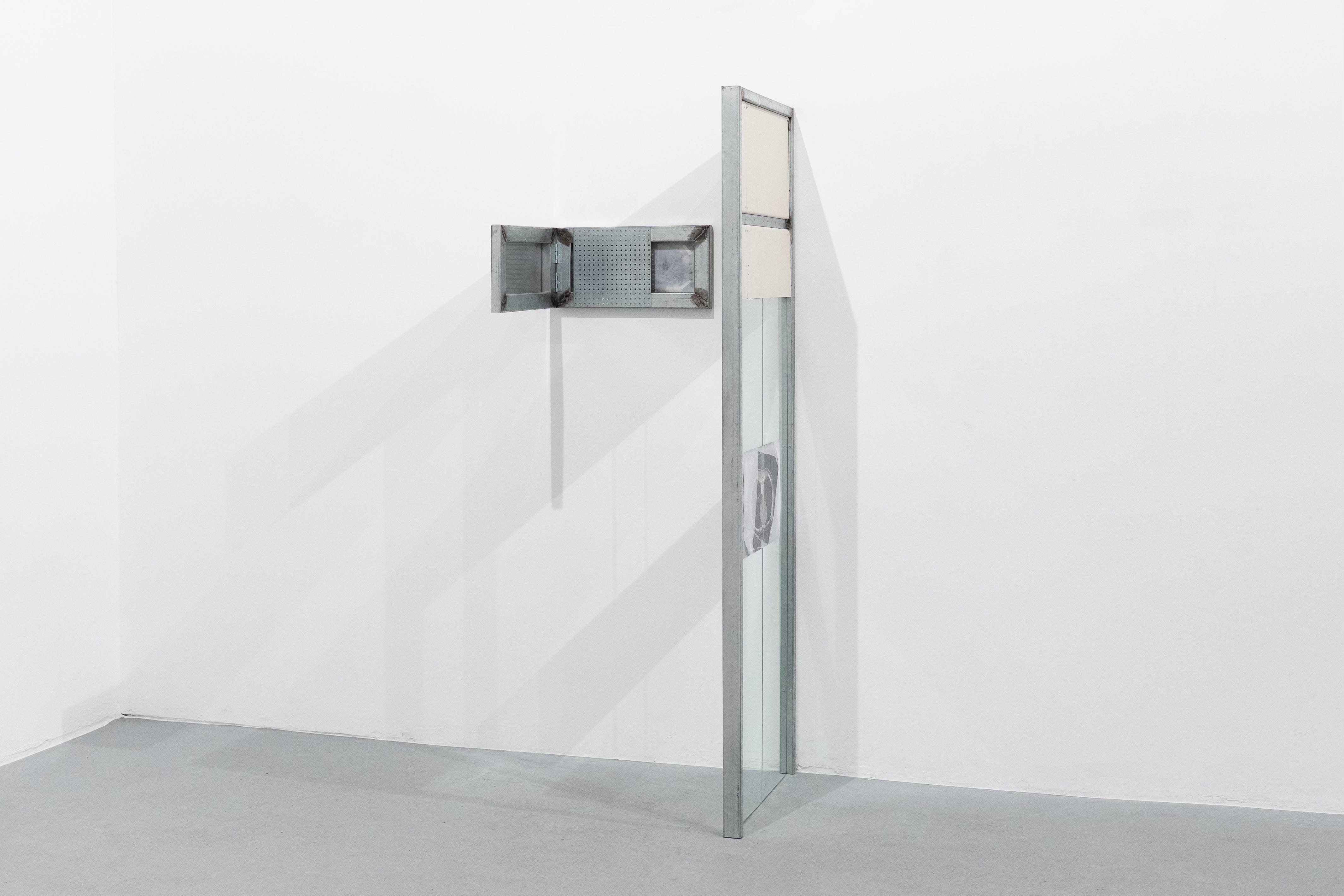
NE: I think there’s a perfect balance struck between them. Because you come in and you’re like, ‘oh, there’s not much.’ Physically, quite literally, you know. But there’s also plenty enough.
GVM: Yeah, that’s the thing. But the space is super specific, right? It’s even a bit odd in a good way. You have a super high ceiling. They’re like five metres tall. But the space is not that wide or long. It’s just very tall.
NE: When I’m here I sometimes feel a bit like I’m in a little tube.
GVM: Yeah, yeah, yeah, that’s it. And if you just place things on the wall, it feels like they’re being swollen. It’s weird. So I feel it’s a space that really calls for sculpture or installation or wall formats that are a bit more sculptural than just flat surfaces for images. And I like that a lot.
Then again, as you’re saying, there are not a lot of works, but they’re all quite intense and complex and multilayered. I feel that when it’s like that, it’s also nice to have space to breathe. It’s nice to not overload the space, because then you just have lots of information in quantity, but you don’t really delve deeper into the little things that you come across. I try to make a nice balance between very present structures and the smaller, very detailed drawings, so that you have to draw closer.
NE: I just think it’s sometimes nicer when there’s less. And then you have the capacity to actually absorb it and think about it and spend time with it. Versus walking in, and say you have like 30 works in this room, crammed in. You’re just going to look at it and be like, okay, my mind can only take so much. I guess it’s museum fatigue on a smaller level.
GVM: Yeah, it’s a bit like that feeling of reading a poetry book. You read very fast and then it’s over and then you’re like, ‘oh, it’s over.’ And then you have to go back to the beginning and then you read it again. That’s also the sense I wanted to create.
NE: That’s such a perfect way of putting it. You really can think that. But then you read it again and again and you’re like, ‘wow, there was actually so much happening here.’
And you wrote the text yourself as well?
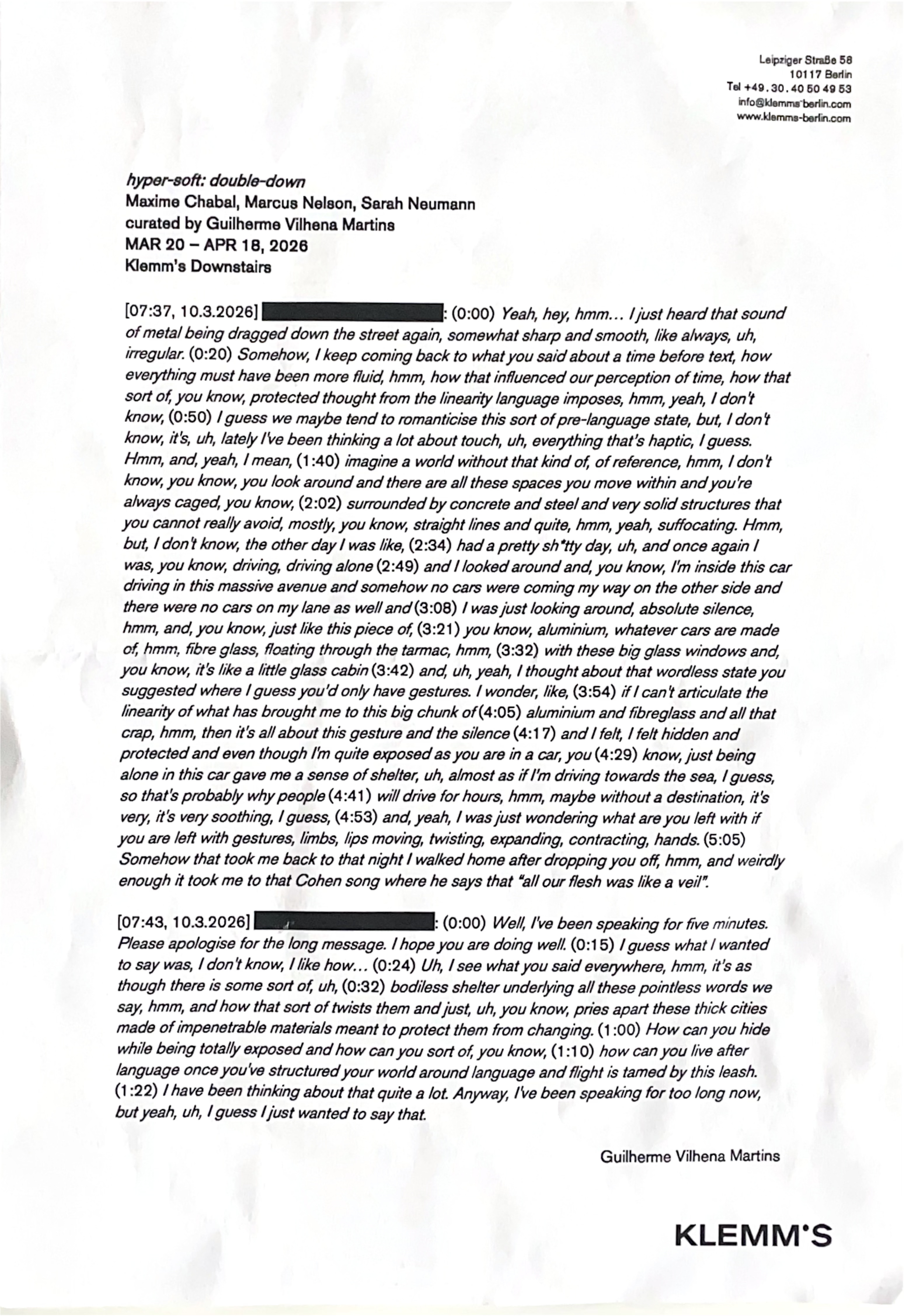
GVM: Yeah, I wrote the text as well, which is a fictional piece. I’ve experimented with this format quite a lot in the past. Redacted stuff, but also using letters as exhibition text. I think that’s something I’ve done quite a lot.
NE: I’ve also been very into this recently, using letters as a medium of writing.
GVM: I especially feel this kind of writing is about creating intimacy within rather anonymous spaces. I felt you really needed something intimate. You know, this feeling of being addressed directly, as though you’re stepping into a conversation. I thought it would make more sense than writing something purely theoretical and explanatory.
I’m talking about this feeling of being isolated in a car. You’re driving around for hours because you’ve had a shitty day and you’re inside this little metal box. You’re hiding somehow. It’s a funny feeling. I recorded this as a voice note and then transcribed it and edited it a bit. And obviously, you know, there’s personal stuff in there, but I didn’t want to make it personal. I wanted to make it look like it’s a personal thing. But the discussion I’m having here or the kind of things I’m addressing are pretty much the core of what’s going on in the works. And I felt that if you established this personal dimension, you would get it quicker. I think it’s a nice layer to add to the show.
hyper-soft: double-down runs until 18 April 2026.